Monday, November 19, 2018


CONCERT

Merkin Hall
What Makes it Great?

Dvořák's American Quartet

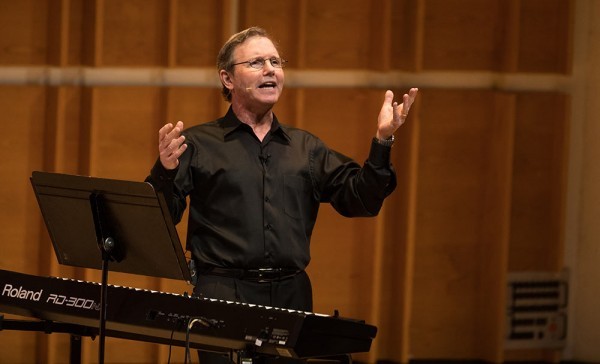
"Listen to iconic masterpieces with new ears as NPR & PBS music commentator, conductor, composer, author and pianist Rob Kapilow shows you what you've been missing!

Featuring the Aeolus Quartet
Antonín Dvořák came to America in 1892 to head the newly-formed American Conservatory of Music, ushering in an extraordinarily fruitful period of creativity that included the triumphant New World Symphony and his Cello Concerto in B minor. In the idyllic surroundings of a small Iowa town, he wrote what would become one of chamber music’s most popular pieces in just 16 days: The String Quartet in F major, nicknamed the "American Quartet." Fascinated with African-American and Native-American music, Dvořák absorbed the spirit of America’s folk melodies into his work and advocated for an American composition school based on the country’s own indigenous music. Rob Kapilow and the Aeolus Quartet explore the difference between influence and imitation as they investigate what makes the American Quartet “American.”


RECITAL

Marble Collegiate Church
Monday Soul Break Concerts


Colin MacKnight finished his program with this piece.  It was wonderful.  At 12:10 after about 4 minutes of the fugue, the original theme thunders back in with the pedals while the fugue continues on with the hands.  It was a magic moment.

Phantasie über den Choral 'Hallelujah, Gott zu loben bleibe meine Seelenfreud'


Tuesday, November 13, 2018


LINCOLN CENTER

Alice Tully Hall
The Chamber Music Society of Lincoln Center

Beethoven - Variations on “Bei Männern, welche Liebe fühlen” from Die Zauberflöte for Cello and Piano, WoO 46 (1801)
Schubert - Sonata in A minor for Viola and Piano, D. 821, “Arpeggione” (1824)
Bottesini - Gran duo concertante for Violin, Double Bass, and Piano (1880)
Schubert - Quintet in A major for Piano, Violin, Viola, Cello, and Double Bass, D. 667, Op. 114, “Trout” (1819)

"While great music can be gripping, heart-wrenching, and profound, it is just as often exactly what’s needed to entertain, distract, and lift the spirits. In a program almost too pleasant for words, CMS offers musical diversions featuring opera melodies, an homage to an extinct instrument, an astounding display of double-bass virtuosity, and Schubert’s beloved masterpiece, composed for friends, based on a song about a fish."


Monday, November 12, 2018


MUSEUM

The Whitney
Andy Warhol—From A to B and Back Again

A video on the exhibit...

"Few American artists are as ever-present and instantly recognizable as Andy Warhol (1928–1987). Through his carefully cultivated persona and willingness to experiment with non-traditional art-making techniques, Warhol understood the growing power of images in contemporary life and helped to expand the role of the artist in society. This exhibition—the first Warhol retrospective organized by a U.S. institution since 1989—reconsiders the work of one of the most inventive, influential, and important American artists. Building on a wealth of new materials, research and scholarship that has emerged since the artist’s untimely death in 1987, this exhibition reveals new complexities about the Warhol we think we know, and introduces a Warhol for the 21st century.

Explore the artworks below to learn more about the life and work of Andy Warhol."

The exhibition positions Warhol's career as a continuum, demonstrating that he didn't slow down after surviving the assassination attempt that nearly took his life in 1968, but entered into a period of intense experimentation. The show illuminates the breadth, depth, and interconnectedness of the artist’s production: from his beginnings as a commercial illustrator in the 1950s, to his iconic Pop masterpieces of the early 1960s, to the experimental work in film and other mediums from the 1960s and 70s, to his innovative use of readymade abstraction and the painterly sublime in the 1980s. His repetitions, distortions, camouflaging, incongruous color, and recycling of his own imagery challenge our faith in images and the value of cultural icons, anticipating the profound effects and issues of the current digital age.

This is the largest monographic exhibition to date at the Whitney's new location, with more than 350 works of art, many assembled together for the first time."


Artworks

By section

1

Warhol Before Warhol

One of Madison Avenue’s most in-demand illustrators
An illustration of a gold shoe.

2

Hand-Painted Pop

Scrutinizing the signs and symbols of postwar America
A painting of a comic book image of Superman.

3

Mechanical Reproduction

Discovering the heroism of everyday objects (over and over again)
A print showing rows of Coca-Cola bottles with a logo at the bottom.

4

Silver Screens

From screen to canvas, Warhol reflects on our obsession with celebrity
Three images of Elvis.

5

Death and Disaster

Exploring the dark side of American culture
An image of a race riot printed on yellow canvas.

6

Most Wanted Men

A controversial mural for the 1964 World's Fair in Queens
Black and white mugshot of a criminal.

7

Flowers

Warhol perfects his systemic approach to art making
Four flowers, two pink and two orange.

8

Filmmaking

Warhol, (super) star maker
Film still of Ethel Scull.

9

Installations

Warhol announces his “retirement” from painting
Silver balloons in a room.

10

Performance and Experimentation

After a near-death experience, Warhol gets back to work
Warhol vacuuming an empty gallery.

11

Mao

Warhol’s take on the most widely reproduced portrait in the world
An image of Mao painted with bright colors.

12

Time Capsules

Boxing (and unboxing) Warhol’s personal archives
A cardboard box.

13

Ladies and Gentlemen

A major series depicts members of New York’s drag and trans community
Painting of Marsha P. Johnson.

14

Still Lifes and Shadows

Questioning how images create meaning
Image of a skull painted in bright colors.

15

Abstraction

A radical new approach to abstract art
Abstract painting in yellows and black.

16

Portraits

Warhol attempts to create a “portrait of society”
Portrait of Debbie Harry.

17

Andy Warhol Enterprises

The Factory expands its ventures in contemporary media
Yoko Ono on the cover of interview magazine.

18

Collaborations

Warhol inspires—and is inspired by—a new generation of artists
Painting with many logos and colorful paint gestures.

19

The Last Supper

A meditation on militancy, spiritual sacrifice, and mourning
The Last Supper screenprinted twice and covered with camouflage paint.


Saturday, November 10, 2018


CONCERT

Carnegie Hall
Dafnis Prieto Big Band

"Cuban-born drummer, composer, bandleader, 2011 MacArthur “Genius” Fellow, and 2018 Latin Grammy nominee Dafnis Prieto honors his musical heroes and mentors—such as Eddie Palmieri, Chico O’Farrill, Michel Camilo, Henry Threadgill, and Steve Coleman—with his 17-piece orchestra. Showcasing some of the world’s best Latin jazz musicians, Prieto’s compositions mix lush and jubilant melodies with polyrhythms that display a range of musical vocabularies from Latin jazz to classical chamber music."


Friday, November 9, 2018


LINCOLN CENTER

David Geffen Hall
New York Philharmonic

Iván Fischer - Conductor
Miah Persson - Soprano
Anthony McGill - Clarinet

Schubert - Symphony No. 5
Schubert / Orch. Reinecke - The Shepherd on the Rock
Beethoven - Symphony No. 4

"The Philharmonic plays Beethoven’s sun-infused Fourth Symphony, which Berlioz described as “an angel singing at the gates of Paradise.” Plus two works by Schubert: his youthful Fifth Symphony and a joyous, charming mini-cantata, featuring Principal Clarinet Anthony McGill and soprano Miah Persson, inhabiting the role of a young alpine shepherd yearning for spring and for his sweetheart across the mountains."


Friday, November 2, 2018


LINCOLN CENTER

Alice Tully Hall
The Chamber Music Society of Lincoln Center

Mozart - Quintet in E-flat major for Two Violins, Two Violas, and Cello, K. 614 (1791)
Reicha - Quintet in B-flat major for Clarinet, Two Violins, Viola, and Cello, Op. 89 (c. 1809)
Glazunov - Quintet in A major for Two Violins, Viola, and Two Cellos, Op. 39 (1891-92)

"The ensemble of two violins, a viola, and cello—the string quartet—is to chamber music as pasta is to Italian cooking: add any good ingredient for a delicious meal. This uncommon program features three disparate and beautiful sonorities of the string quartet augmented by a trio of contrasting instrumental voices, performed by an equally rich assemblage of CMS artists."